
Major Product Highlight at CIIF | ALINX Unveils Zynq UltraScale+ MPSoC System-on-Modules Based on the oHFM Standard
FPGA modules are moving from proprietary designs toward standardization. From October 12 to 16, 2026, the 26th China International Industry Fair (CIIF) was held in Shanghai. At the event, ALINX officially showcased its AMD (Xilinx) Zynq UltraScale+ MPSoC series System-on-Modules (SoMs) based on the open oHFM (Open Harmonized FPGA Module) standard.
The debut of the oHFM Zynq UltraScale+ MPSoC series marks a significant step in ALINX's efforts to bring standardization from technical specifications into commercial hardware products.

The oHFM Standard
A Common Foundation for Modular FPGA Development
As FPGA applications evolve toward higher performance and greater modularity, hardware compatibility and reusability are becoming increasingly important.
For years, FPGA modules from different manufacturers have varied in dimensions, interface definitions, pin assignments, and other design specifications. When developers replace modules or upgrade platforms, they often need to redesign and adapt their hardware, increasing development costs and reducing the efficiency of hardware reuse.

The oHFM standard was developed to address these challenges.
Promoted by SGET, the international organization for embedded technology standards, oHFM targets FPGA and SoC-FPGA modules. By standardizing module dimensions, interfaces, and connection methods, it establishes a common technical foundation for module and carrier board design.
Currently, oHFM defines two form factors:
oHFM.c | Connector-Based Modules
Designed for applications such as high-performance FPGAs, prototyping, and upgradeable systems.
oHFM.s | Solderable Modules
Designed for mass-production applications, helping optimize space utilization and system integration.
By establishing unified module design specifications, oHFM provides a new approach to hardware platform compatibility, carrier board reuse, and product iteration.
Turning Standards into Products
ALINX Introduces the Zynq UltraScale+ MPSoC Series SoMs
Throughout the five-day CIIF exhibition, ALINX showcased its oHFM-based Zynq UltraScale+ MPSoC series SoMs.
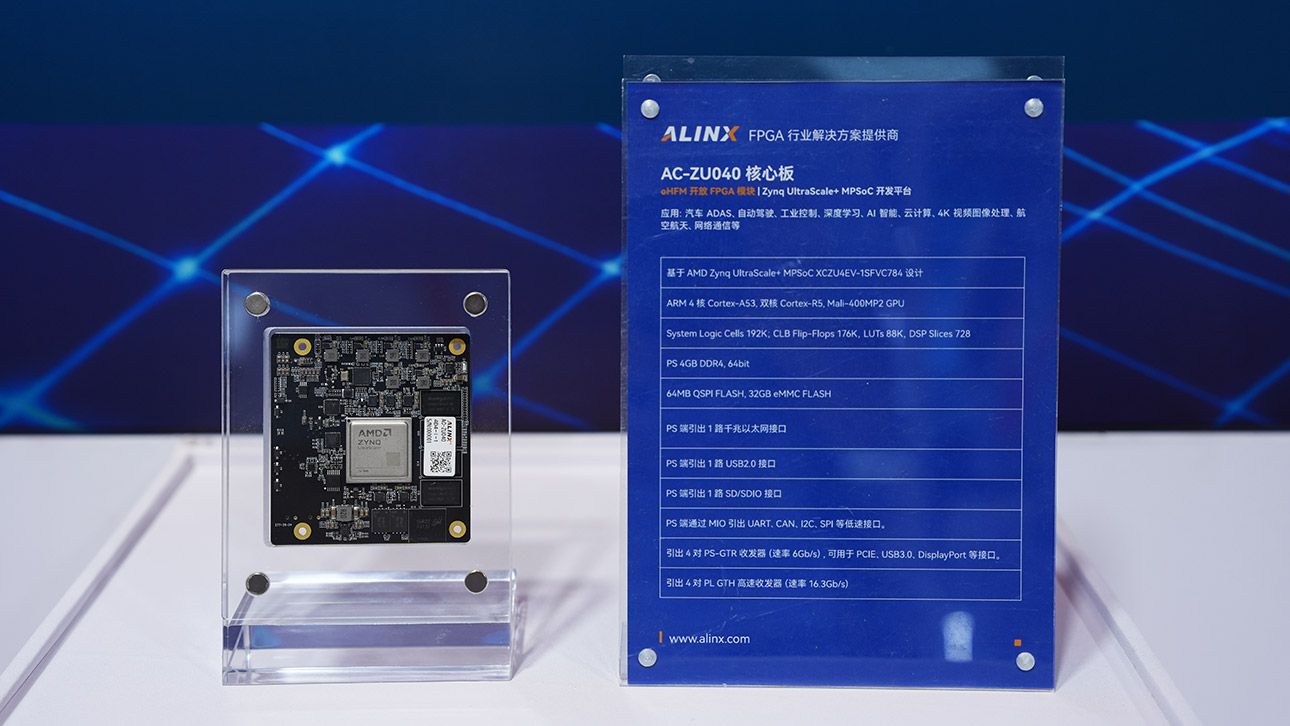
Built around AMD Zynq UltraScale+ MPSoC devices, these SoMs integrate processing capabilities, memory resources, and interfaces into standardized modules. They support applications such as high-performance processing and prototyping, providing a hardware platform for industrial control, machine vision, edge computing, high-speed data processing, and other demanding applications.
In July 2026, ALINX joined SGET, becoming the first member from mainland China to join the oHFM Standards Committee. The launch of these SoMs represents a concrete step in applying the standard to product design following ALINX's involvement in its development.
From standards working groups to product development, ALINX is translating its participation in and understanding of modular hardware standards into tangible, application-ready products.
Enabling Industrial Applications
Advancing the FPGA Modular Ecosystem
For manufacturers and system developers, hardware platforms must not only meet performance requirements but also support development efficiency, product iteration, and long-term maintenance.
Standardized FPGA modules offer a new approach to meeting these needs. As more compatible products and carrier boards become available, developers can reduce repetitive design work and devote more resources to algorithm development, system integration, and application innovation.

As a provider of FPGA SoMs, development platforms, and industry solutions, ALINX will continue to advance the development and application of standardized modules, working with industry partners to expand the adoption of oHFM across industrial computing, edge computing, and other fields.
Bringing standards into products and products into real-world applications, ALINX will continue to focus on FPGA technology and industry applications, driving modular hardware platforms toward a more open and flexible future.